Wheel RTP, Volatility and Hit Frequency in a Short Mobile Session

You have a few minutes on mobile data, PHP 500 in your e-wallet, and a Wheel game open on your phone. Its return figure may look reassuring, but it cannot tell you what those few minutes will pay. To judge the risk of a short session, you need to read return-to-player, volatility and hit frequency as three different measures.
They answer different questions. RTP describes a long-run average across many wagers. Volatility describes how uneven the results can be. Hit frequency describes how often a spin produces a payout, including payouts smaller than the stake. None of them predicts your next landing.
Read the return figure without treating it as a session target
Return-to-player, or RTP, is the portion of total stakes a game is designed to pay back over a very large number of rounds. It is a mathematical average, not a refund schedule. If a hypothetical Wheel game had 96% RTP, PHP 100,000 in combined stakes would correspond to PHP 96,000 in expected payouts across the model. That does not mean a player staking PHP 500 should expect PHP 480 back.
Even that hypothetical PHP 96,000 is an expectation rather than a guaranteed total. Real results move around it, and a short session can land far above or below the average. The difference between stakes and payouts also matters: a payout includes the returned stake where the game's rules say it does, so it is not automatically profit.
- Open the Wheel game's information or paytable and find the RTP for the exact version and stake option you intend to play.
- Check whether the wheel has separate bet types, because different selections may use different payouts and return figures.
- Read the payout table beside the wheel layout; a large prize on one segment says little without its likelihood.
- Use the figure to compare game designs, while keeping your session budget based on money you can afford to lose.
A label on a lobby tile may be less specific than the game screen. When the two differ, inspect the in-game rules before placing a stake. If you cannot find a clear return figure, ask support where the current game information is displayed.
A peso example that separates hits from profit
Suppose you stake PHP 20 on each of ten hypothetical spins. Your total stake is PHP 200. Imagine six spins produce payouts of PHP 10 each and four produce nothing. You saw a payout on six spins, yet received only PHP 60 back. Your session result is a PHP 140 loss.

Now imagine a different ten-spin sequence with one payout of PHP 300 and no payouts on the other nine spins. That sequence has fewer hits, but its PHP 300 return leaves you PHP 100 ahead on the same PHP 200 staked. These examples show why a busy-looking wheel can still drain a balance, while a quieter one can occasionally deliver a larger result.
Six hits in ten spins would be a 60% observed hit rate for that tiny sample. It would not establish the game's published hit frequency. Ten spins are too few to estimate the underlying rate reliably, and two players can have very different sequences without either result contradicting the game's design.
What volatility feels like during a short break
Volatility concerns the size and spread of payouts. A higher-volatility Wheel design may concentrate more of its return in rare, larger prizes, leaving longer stretches without a meaningful payout. A lower-volatility design may pay more often in smaller amounts. Neither description means a player will finish ahead.
That distinction matters when you play between errands or during a commute. You may have time for only a handful of spins. A long-run RTP has little power to describe that handful, while the payout pattern strongly affects how quickly the balance can change. A large advertised top prize can be attractive, but it does not reveal how often smaller results occur.
Some games publish a volatility label or describe their prize distribution; others rely on a paytable. Read the full spread of outcomes rather than focusing on the largest segment. If most available payouts are below your stake, a frequent hit may soften a loss without reversing it.
- Compare the smallest available payout with your chosen stake, because a result below the stake still reduces your balance.
- Look for how many outcomes pay nothing, while remembering that visible segment sizes may not represent their actual probabilities.
- Check whether a special segment leads to another round, since its final value may depend on additional rules.
- Choose a stake that leaves room for several rounds if you want to observe play without exhausting the session immediately.
Visual design can mislead here. A wheel may display equal-looking slices while assigning different probabilities through its rules. The paytable and game information are better guides than the artwork.
Hit frequency is about payouts, not winning sessions
Hit frequency is the proportion of rounds that produce some payout under a game's stated definition. It does not say how large those payouts are, and it does not say how many sessions end in profit. One game can pay often but return less than the stake on many of those hits. Another can pay less often but offer larger individual returns.
When comparing Wheel games, check what counts as a hit. A feature trigger, a stake returned, and a small cash payout may be treated differently in game information. If the page gives a hit rate without defining it, the figure alone is too thin to guide your choice.
A streak also does not tell you when the next hit is due. For independent spins under the same rules, earlier misses do not improve the next spin's chance. The same applies after several payouts: a win does not make the following spin inherently less likely to pay. Check the rules for features that explicitly carry progress between rounds before making that assumption.
If Free Credits fund a spin, separate that promotional balance from cash you deposited when assessing your own result. A Bonus can also have game contribution or withdrawal conditions. Those conditions affect what you can take out, while the wheel's payout rules still determine the spin itself. Read the relevant terms before treating a displayed balance as withdrawable money.
Keep the maths usable on a phone
You do not need a spreadsheet during a five-minute session. A simple stake ceiling and a record of settled rounds will tell you more about your own spending than watching the wheel for patterns. For example, PHP 500 divided into PHP 20 stakes allows at most 25 spins if nothing pays back. Any payouts may extend play, but they do not increase the amount you initially chose to risk.
Decide on the maximum loss before transferring money from an e-wallet or paying at a payment centre. During the Christmas build-up, that limit is easier to respect when you keep money for travel, gifts and bills outside the gaming balance. The calculation is personal: RTP cannot decide whether a stake fits your budget.
- Set a peso limit for the session before opening the cashier, and keep essential spending outside that amount.
- Choose one stake size and calculate how many unpaid rounds that balance could cover before you begin.
- Record total stakes and settled payouts separately, so a frequent small payout does not look like a profit.
- Stop at your chosen loss or time limit, even if the most recent spins formed a noticeable streak.
Changing stakes to recover a loss can make the next result more consequential without changing its probability. If your break ends, leave the session there. A short session has no mathematical need to reach the game's average.
When mobile data interrupts a spin
A weak connection can make an animation freeze or delay the result shown on your phone. That screen state is not proof that the wager failed, and tapping again may start another round once the connection returns. Before counting a spin as a miss, a hit or an unpaid round, check its settled status.
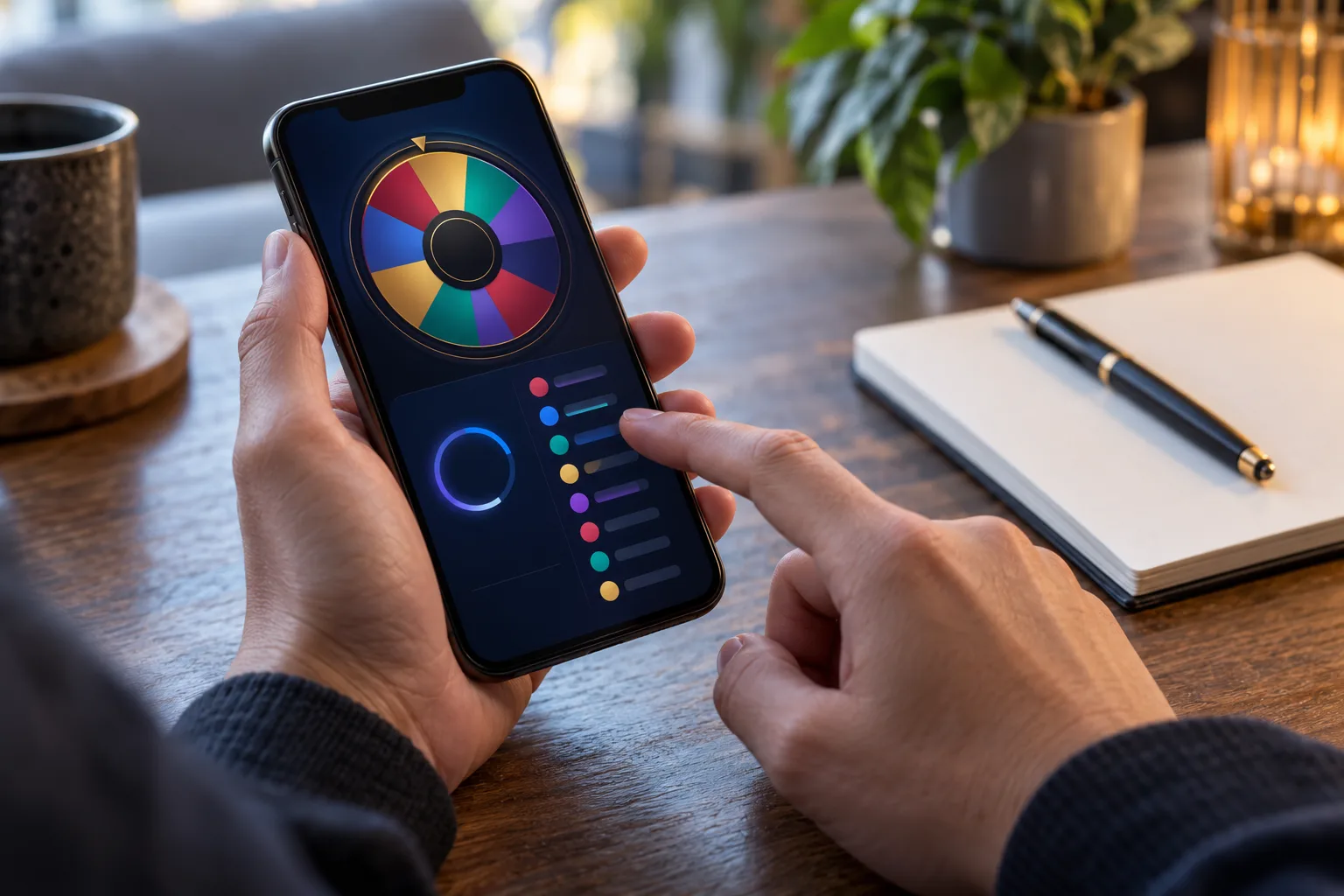
- Wait for the game to reconnect, then open the round history and look for the wager you just placed.
- Compare the round record with your balance change, using the transaction reference if the game displays one.
- Capture the round record and balance view if they disagree, then ask support to review that specific wager.
This matters for the maths as well as the balance. A loading wheel is not a result. Counting unresolved rounds as losses can distort your record, while repeating a tap can increase your total stake. If an e-wallet transfer also appears delayed, check its transaction status and the cashier history separately before sending another payment.
The useful question before the next spin
For a mobile player, the practical question is not whether a Wheel game is about to pay. It is whether its payout pattern, stake and rules suit the amount of time and money available. RTP helps compare the long-run design. Volatility describes how uneven the ride may be. Hit frequency tells you how often some payout may appear, provided you know what the game counts as a hit.
Read those figures together with the paytable, then set a limit that works even if the next few spins pay nothing. A small sample can be enjoyable or disappointing. It cannot promise the long-run average, and it cannot reveal a due result.